
Lithium battery charging and protection integrated board with 5V input, 4.2V ±1% cut-off, 1000mA maximum charging current, and 2.6x1.7cm dimensions for 18650 Li-ion cell management in DIY electronics projects and power banks


Lithium battery charging and protection integrated board with 5V input, 4.2V ±1% cut-off, 1000mA maximum charging current, and 2.6x1.7cm dimensions for 18650 Li-ion cell management in DIY electronics projects and power banks
Lithium Battery Charging and Protection Integrated Board for 18650 Cells and DIY Power Banks

This compact 2.6cm by 1.7cm board combines the essential functions needed to safely charge and protect a single lithium-ion or lithium-polymer battery cell. Designed for integration into DIY projects, power banks, or other electronic devices, it simplifies power management by handling the charging algorithm and critical protection protocols on one piece of hardware. The board accepts a standard 5V input—compatible with many USB chargers and power supplies—and delivers a controlled charge to the battery up to a maximum current of 1000mA. By incorporating over-discharge and overcurrent protection, it aims to help extend battery life and provide a safer operating environment for your project.
Features and Construction
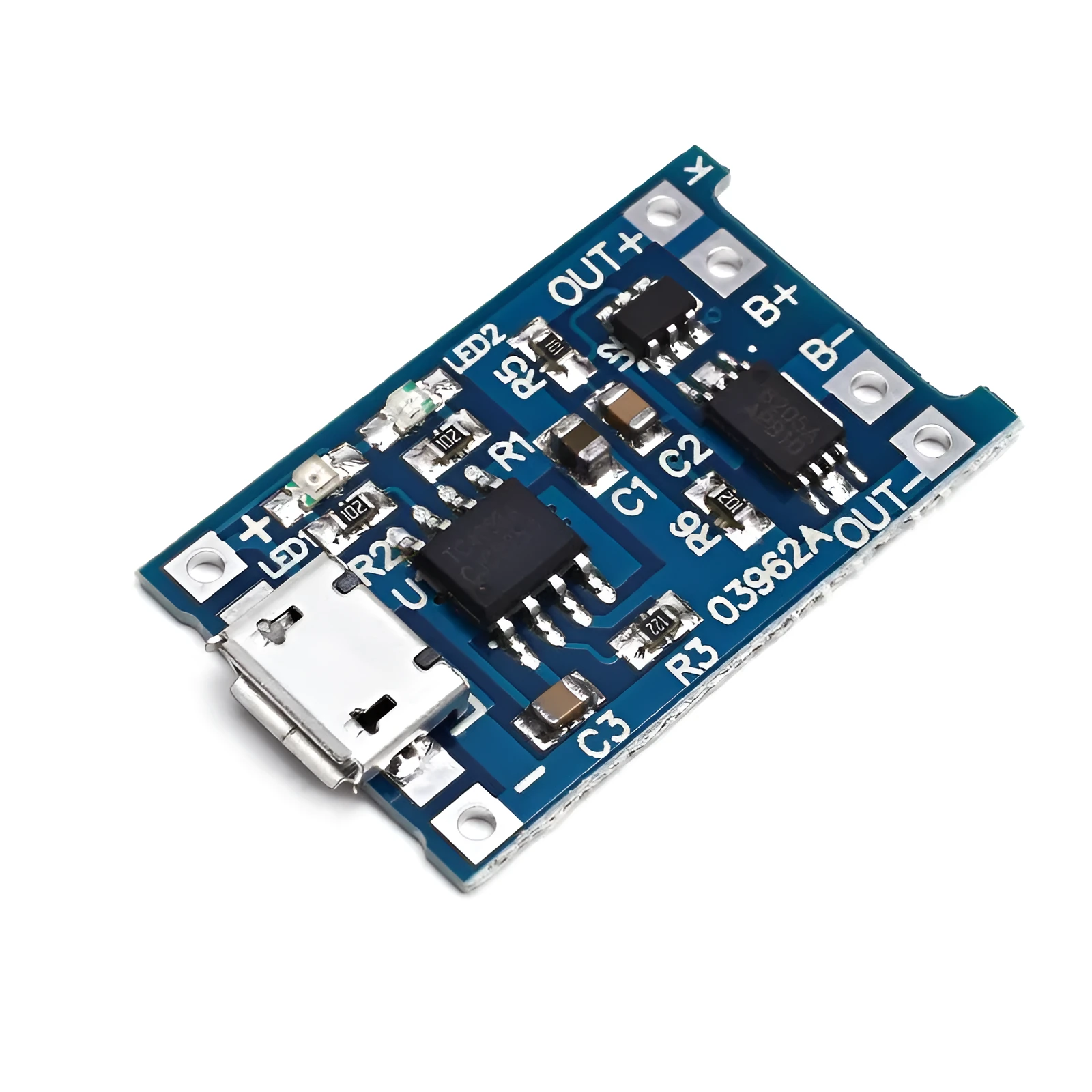
This board is built around an integrated circuit that manages both the charging process and the battery protection functions. The main components are populated on a blue printed circuit board, resulting in a finished unit ready for soldering connections. Its design prioritises a compact footprint for easy integration into space-constrained projects.
Material and Build
The core construction is a standard printed circuit board (PCB) which hosts the integrated charging and protection IC, supporting resistors, capacitors, and connection points. The blue solder mask gives the board its distinctive colour. The build is focused on functionality, providing the necessary circuitry to manage a lithium cell without requiring separate charging modules and protection circuits.
Size and Practical Fit
With dimensions of 2.6 centimetres by 1.7 centimetres, the board has a small, rectangular footprint. This size makes it suitable for embedding into custom power bank enclosures, portable projects, or other electronic assemblies where space is a consideration. Its compact nature means it can be fitted into many designs without requiring significant layout changes.
Uses and Placement

The primary use case for this board is managing single-cell lithium batteries, most commonly the 18650 format found in many consumer electronics and hobbyist projects. It serves as a central component for building a safe and functional power source.
Event or Professional Use
For professional prototyping, makerspaces, or educational electronics workshops, this board provides a ready-made, reliable solution for battery management. It allows creators to focus on their core project design rather than developing a custom battery charging and protection circuit from scratch. It can be integrated into demonstration units, portable test equipment, or custom tools that require autonomous battery power.
Everyday Home Use
DIY enthusiasts can use this board to create custom power banks for charging mobile devices, build battery-powered LED lighting, or construct backup power for small gadgets like Raspberry Pi projects or wireless speakers. Its predefined parameters simplify the process, making it accessible for those with basic soldering and electronics skills who want to incorporate a rechargeable lithium cell safely.
Benefits and Buying Value

The value of this integrated board lies in its combination of functions and its specific, fixed parameters that cater to a common battery type. It removes the need to source and wire multiple discrete components.
Reuse and Low Maintenance
As a solid-state electronic component, the board itself requires no maintenance. Its integrated design means there are no moving parts to wear out. Once correctly installed and connected to a suitable battery and power source, it operates automatically each time the battery is charged or discharged, providing consistent protection across multiple charge cycles.
Why Choose This Product
This product is a practical choice for anyone needing a straightforward, all-in-one solution for charging and protecting a standard 18650 lithium cell. The key differentiators are its compact 2.6cm x 1.7cm size, its integrated design combining two functions, and its set parameters including 5V input, 1000mA max charge current, and 3A overcurrent protection. It is particularly suited to applications where building a protection circuit from individual components is impractical or beyond the user's skill level.